
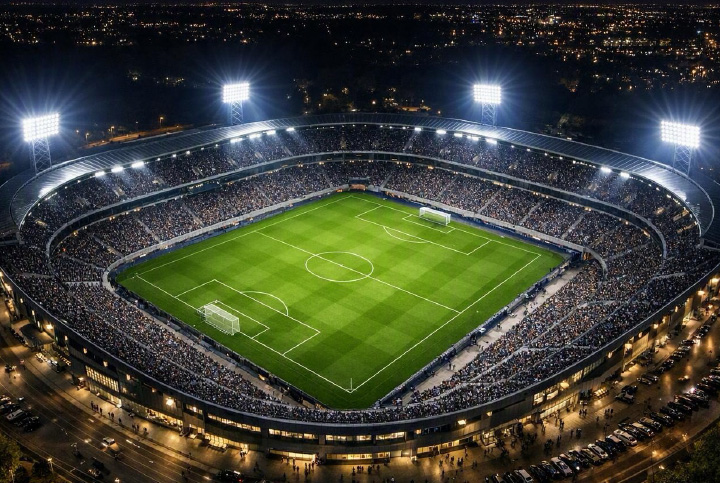

Why are sports venues trading Metal Halide for LED?
The emergence of LED sports lighting has been a major shift in stadium and field design, rapidly replacing traditional HID (High-Intensity Discharge) fixtures such as metal halide. This transition is one of the biggest upgrades in sports lighting over the past decade.
Why are LEDs replacing HID in sports lighting?
Here are some of the major benefits of LEDs sports lighting:
1. Superior lighting control.
HID fixtures emit light in a fixed, broad pattern; on the other hand, LEDs can be paired with precise optics. As a result, they provide better targeting of light onto the field, less light spills into neighborhoods, and reduce glare for players and spectators.
2. Instant on/off (no warm-up time).
HID fixtures require 10–20 minutes to reach full brightness. After a power interruption, they need time to re-strike. On the other hand, LEDs deliver instant full brightness.
3. Energy efficient.
LEDs use 40–70% less energy, deliver more usable light (better direction) that significantly reduces operating costs and carbon footprint.
4. Long lifespan and low maintenance.
HID fixtures typically last 6,000–15,000 hours, on the other hand, LEDs last 50,000 hours or more. HID fixtures require frequent re-lamping; on the other hand, LEDs require fewer replacements and lower maintenance costs.
5. Better light quality.
LEDs provide higher uniformity, better color rendering (CRI), and stable output (less lumen depreciation over time).
6. Advanced controls and smart systems.
LED systems integrate with:
– DMX / lighting control systems.
– Dimming and zoning.
– Dynamic effects (color change, strobing).
7. Reduced glare and improved comfort.
Modern LED sports fixtures use:
Shielding, precision aiming, custom beam angles which provide less glare for athletes, better visibility of fast-moving objects, and improved safety.
8. Environmental and community benefits.
LED systems reduce light trespass, lower skyglow (better for dark skies), and contain no mercury (unlike HID lamps).
Key comparison between HID vs LEDs sport lighting
Feature | HID (Metal Halide) | LED |
Startup time | Slow | Instant |
Energy use | High | Low |
Lifespan | Short | Very long |
Light control | Limited | Highly precise |
Maintenance | Frequent | Minimal |
Dimming | Poor | Excellent |
Broadcast quality | Moderate | Excellent |
To light up a sports facility or arena is not as simple as turning a switch. Different sports facilities require different lighting levels depending on the field size and the number of spectators.
The industry standard for sports lighting is primarily dictated by the Illuminating Engineering Society (IES) under the ANSI/IES RP-6-15 guidelines. It utilizes a tiered “Class” system to standardize lighting performance according to the level of play and number of spectators. These classifications are critical for facility managers and contractors to meet the minimum brightness of various facilities.
According to the IES classification system, they are divided into 4 classes.
o Class 1: Professional and National Competition.
This is the highest standard and is designed for professional sport arenas such as for NFL & NCAA Division I with over 5000 spectators. These arenas require the highest illuminance (100-150fc).
o Class 2: Intermediate and Regional Competition.
This class applies to high level amateur or collegiate sport arenas. Usually, the number of spectators is up to 5000 people. These arenas require (50-75fc).
o Class 3: Recreational and High School Competition.
This class applies to high school gyms and small sport clubs. The focus is mainly on safety and general visibility. Usually, the number of spectators is under 2000 people. The target illuminance is around 30-50fc.
o Class 4: Social and Training.
This class applies for most elementary school and social play. The number of spectators is very minimal. The target illuminance is around 10-30fc.

We, at NaturaLED, provide an in-house lighting layout service to help our customers make better decisions in various facility classifications. Additionally, all our LED sport lighting is listed under UL 1598 and DLC (DesignLights Consortium) QPL list for safety and performance. Not only that, but our LED sport lighting is also dimmable (0-10v) to meet the California energy codes mandate for specific Lighting Power Densities (LPD) and control strategies, such as occupancy sensing and multi-level dimming.
The bottom line
The shift from HID to LED in sports lighting is not just a minor upgrade, it’s a complete transformation. It’s a win a win solution for everyone.
• Efficiency wins:
Shift from broad, inefficient lighting to precise, controlled illumination.
• Experience wins:
Shift from static systems to dynamic, smart environments, instant-flicker free lighting.
• Longevity wins:
Shift from maintenance-heavy to long-lasting solutions.
• Economics win:
Shift from high to lower energy cost.
LEDs sports lighting, combined with IES-based design, has made sports lighting more efficient, accurate, and visually impressive than ever. They are more than just a fixture count. It’s a strategic investment that affects athlete performance, safety, and operational costs.

