What is Human Centric Lighting and Why Should I Care?
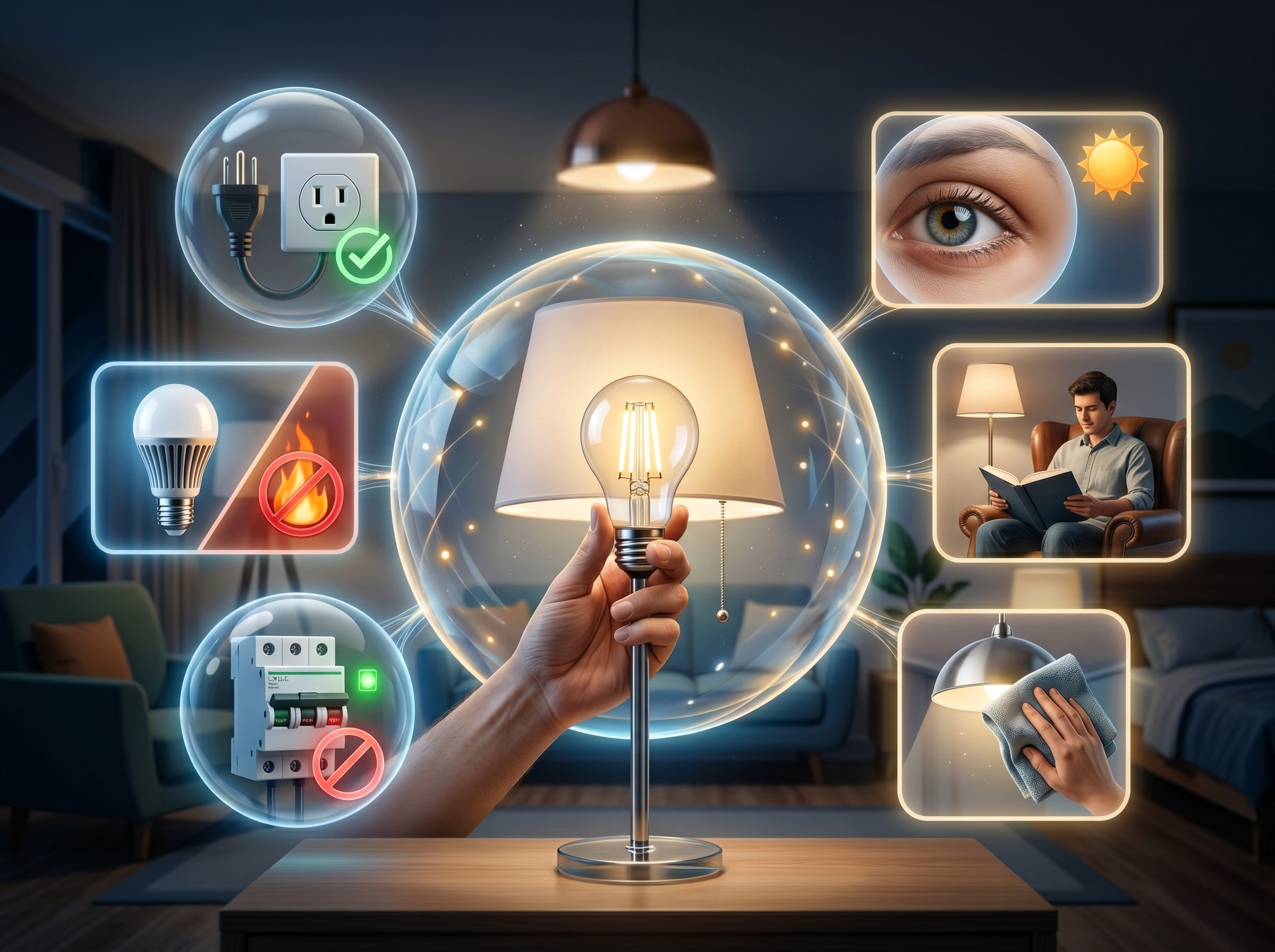
When quality and compatible fixtures are installed and maintained properly, good lighting will not only be comfortable and efficient, but safe. Let’s take a look at a consumer-focused guide to lighting safety, so you can reduce or eliminate electrical and fire risk, and avoid eye/health damage.
Electrical safety fundamentals (before you buy)
Verify the product’s ratings and compatibility
• Check to be sure the fixture you’re buying is listed for the environment you’ll be using it in:
• Dry indoor vs damp/wet locations (bathrooms, garages, outdoor areas).
• Ingress protection (IP rating) for outdoor or moisture-prone areas (e.g., IP44 and above is commonly required for many damp/wet applications, but always follow the product marking).
• Confirm the product’s electrical specifications match your supply:
• Voltage and frequency (e.g., 120–277V systems vs higher voltage regions).
• Current rating if the fixture uses a specialized driver or control gear.
• Look for certification marks on the product (commonly UL/ETL/CE or local equivalents). Certification indicates the product passed safety testing for its intended use.
Avoid mismatched components
• Don’t mix dimming gear and lamps/drivers that aren’t compatible with each other. Many flicker, buzzing, or early failure issues come from incompatible dimming protocols (leading/trailing edge) and driver behavior.
• Use lamps/LED modules only where the fixture manufacturer allows it (socket type, wattage limits, and thermal requirements).
Installation safety: reduce shock, arcing, and overheating issues
Turn off power correctly
• Switch off at the breaker, then verify with a voltage tester (non-contact testers can miss issues—use a proper meter if available).
• If you’re unsure whether a circuit is de-energized, treat it as live and stop.
Wiring practices that prevent failures
• Use the correct wire gauge and insulation type for the circuit and enclosure.
• Ensure wire connections are rated for the application (wire nuts, lever connectors, or other listed connectors).
• Maintain conductor tightness and torque:
• Loose connections can create hot spots that degrade insulation and can trigger fire.
• Keep splices and drivers inside appropriate enclosures—especially where heat and moisture may occur.
Grounding matters
• For fixtures that require grounding (most metal housings), connect to the equipment grounding conductor. A missing or uninstalled ground can increase shock risk and can cause EMI/overvoltage protection behavior to be unreliable.
Respect insulation contact rules
• Many recessed LED housings have restrictions for insulation contact (e.g., “IC rated”).
• If a housing is not rated for direct contact, maintain the required clearance. Trapped insulation can raise internal temperatures beyond driver or LED module limits, reducing life and increasing risk.
Handle drivers and high-voltage components safely
• LED lighting often uses constant-current drivers or constant-voltage power supplies.
• Drivers can contain live circuitry and stored energy even after power is off. Don’t open fixtures or replace drivers unless you’re following the manufacturer’s service instructions and the replacement part is exact.
Fire safety: managing heat and combustibles
Understand why heat is a safety issue
• LEDs are more efficient than many traditional sources, but heat still exists—primarily in:
• The driver (electronics).
• The LED module/thermal path (the small semiconductor junctions require heat dissipation).
• Overheating accelerates failure mechanisms: driver component degradation, solder joint fatigue, and insulation breakdown.
Thermal design compliance
• Don’t cover ventilation openings on fixtures.
• Use the recommended trim rings, covers, and lens types; these parts are often part of the thermal system.
• For enclosed or recessed luminaires, verify the fixture’s maximum ambient temperature rating (Ta) and typical ceiling/plenum conditions.
Use proper dimming and driver loading
• Some dimming methods stress drivers (especially low-end dimming where current regulation becomes harder).
• If you observe persistent flicker, buzzing, or abnormal heat at low brightness, stop using that dimming setup and align to the manufacturer’s supported dimming method.
Moisture, outdoor use, and bathroom safety
Choose the right enclosure and sealing
• For damp/wet areas, ensure the fixture is rated for that location and that all required gaskets and covers are installed.
• Avoid leaving junction boxes exposed outdoors without weather-rated enclosures.
Prevent condensation
• Cold surfaces with warm humid air can cause condensation inside fixtures if seals are compromised.
• Condensation increases corrosion risk and can create leakage current pathways.
Cable routing and strain relief
• Outdoor-rated cable and fittings should be used.
• Provide proper strain relief so tugging doesn’t stress internal wiring.
Photobiological risk (blue light) considerations
• High-brightness LEDs can be engineered within safety limits, but risk depends on distance, optical concentration, exposure time, and optics.
• Use manufacturer instructions for intended use:
• Avoid staring directly into high-output sources.
• Prefer diffused or shielded optics in areas where people look directly (task lighting, vanity areas, exposed ceiling spots).
Battery and plug-in accessories: safety with “smart” lighting
If your setup includes plug-in modules, smart bulbs, or controllers:
• Use manufacturer-approved power adapters and cables.
• Confirm the adapter has:
• Appropriate voltage/current rating.
• Safety certifications.
• Don’t run cables under carpets or through doors where they can be mechanically stressed.
• Inspect cords for cuts, pinching, or wear; replace if damaged.
Surge protection and power quality
Surge events are common
• Lighting drivers and electronics can be sensitive to surges.
• Use a surge-protected power strip or whole-home surge protection when appropriate.
Dimming and compatibility
• Phase-cut dimmers can produce noise and electrical stress.
• If the driver supports only specific dimmer types, use those. Otherwise expect:
• Flicker at low brightness.
• Reduced life due to overstress conditions.
Maintenance and troubleshooting: how to maintain safety and performance
Regular checks
• Periodically inspect:
• Loose fixtures, discoloration, or browning around connections.
• Any buzzing, repeated cycling, or unusually high surface temperature.
• Weather seals (outdoor).
• If you see signs of heat damage at junctions, stop use and repair.
Cleaning and handling
• Power off before cleaning.
• Use dry methods unless the manufacturer states wet-clean capability.
• Avoid harsh chemicals that can cloud lenses or degrade gaskets.
Replace parts correctly
• Use replacement drivers and parts only if the manufacturer specifies them.
• Don’t “upgrade” drivers or LED modules beyond compatibility requirements (wattage, current, dimming protocol, thermal constraints).
Here’s a quick “consumer checklist” you can use:
• Buy fixtures with correct location rating(dry/damp/wet) and proper certification.
• Ensure electrical specs match your supply and wiring method.
• Install using correct wire gauge, connectors, grounding, and torque-tight connections.
• Confirm insulation clearance for recessed fixtures (IC vs non-IC rated).
• Don’t block ventilation or cover fixtures unless explicitly allowed.
• Use compatible dimmers and ensure the driver/lamp supports that dimming method.
• Choose optics that reduce glare for your task and viewing angle.
• Use surge protection and avoid damaged cords/accessories.
• Inspect periodically for overheating signs, seal issues, and loose components.
In order to ensure safety in lighting you need to see lighting as a whole system and not just individual components. Electrical compatibility, thermal management, mechanical integrity, and optics all interact. By selecting correctly rated products and installing them with attention to connections, grounding, sealing, and dimmer compatibility, you reduce shock and fire risk while improving visual comfort and longevity. naturaLED lighting is designed to be reliable—but your installation practices and maintenance schedule will ultimately determine whether your lighting installation is truly safe.