
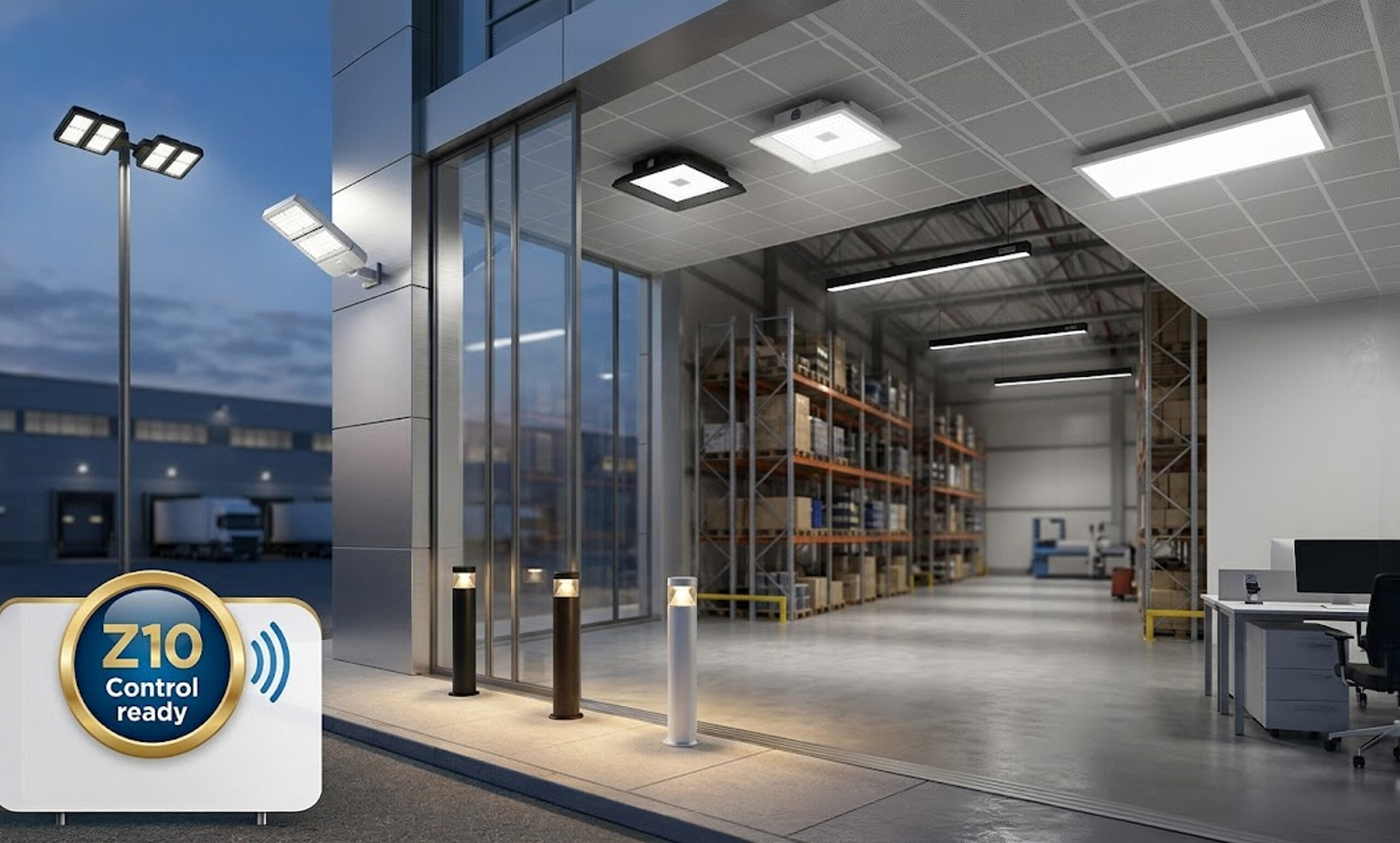

How does it work in today’s application?
A Z10 controller is a smart, twist and lock controller, (often referring to a 0–10V dimming controller, sometimes informally called “Z10”) is a control method widely used in modern lighting systems—especially for LED drivers. It operates using a low voltage plug and play interface which offers a simple upgrade lighting control without needing to rewire the fixtures.
What is a Z10 (0–10V) Controller?
A Z10 controller is part of an analog dimming system where a control transmits a low-voltage DC signal (0 to 10v) to the LED driver to adjust brightness level of a light fixture. It is one of the most used wireless analogs dimming methods, especially in commercial and industrial environments. Each voltage level corresponds to a specific light output, where 0V typically represents off or minimum output and 10V represents maximum (100%) brightness.
This method is simple and reliable. All fixtures connected to the same control circuit dim together at the same level, making it suitable for applications where uniform control is sufficient.
The Physical Z10 Connection.
Think of the Z10 as a specialized, standardized “plug”. The sensor twists and locks directly into a receptacle on the lighting fixture. It provides power to the sensor and relays low-voltage dimming signals (0-10V) to the fixture’s LED driver.
How It Works (Step by Step)
1. Separate Control Circuit.
The lighting system has:
- Line voltage (to power the fixture)
- Low-voltage control wires (for dimming)
The Z10 controller adjusts the control voltage.
2. Voltage Sets Light Output.
The controller sends a voltage signal to the LED driver:
Control Voltage | Light Output |
10V | 100% |
7V | 70% |
3V | 30% |
0-1V | Minimum/off |
3. LED Driver Interprets the Signal.
The driver inside the fixture converts that signal into:
- Adjusted current to LEDs
- Smooth dimming output
Detection.
Z10 motion sensors use Passive Infrared (PIR) or Microwave technology to detect movements in their environment.
- PIR: These sensors monitor “heat signatures”. When a person or vehicle moves through its detection zone, the sensor detects the sudden change in infrared energy and triggers the light.
- Microwave: These emit high-frequency radio waves and measure the reflections that bounce back, signaling movement if the wave frequency gets disrupted.
Smart Controls & Dimming.
Once movement is detected, the sensor acts as the “brain” for the light:
- Occupancy/Vacancy: The light turns on when movement is detected and automatically dims or shuts off after a set period (hold-time) where no motion is observed.
- Daylight Harvesting: Many Z10 motion sensors also have integrated photocells. They measure how much natural sunlight is available and will dim or turn off the artificial light if the sun provides enough illumination.
Customization & Networking.
The sensor’s settings can typically be configured in two ways:
- Remote Programming: an IR remote can be used from the ground to tweak the detection sensitivity, hold-time, and dim brightness.
- Bluetooth Mesh: Many modern Z10 sensors communicate wirelessly. Multiple sensors and fixtures form a wireless mesh network, that will allow us to control and adjust the whole facility lighting zones right from a smartphone app.
Advantages of Z10 controller systems.
- Simple and proven dimming method.
- Cost-effective for large fixture groups.
- Easy installation and troubleshooting.
- Widely supported by LED drivers.
Z10 controller systems are commonly used in warehouses, schools, offices, parking areas, and industrial spaces where individual fixture control is not required.
How It’s Used in Today’s Lighting Applications:
1. Commercial Buildings.
- Offices
- Warehouses
- Schools
- Parking areas
Used for:
- Manual dimming (wall controls)
- Integration with building automation systems (BAS)
2. Daylight Harvesting.
- Sensors adjust Z10 signal based on sunlight
- Lights dim automatically to save energy

- Simple Lighting Zones.
Z10 is ideal when:
• We don’t need complex digital addressing
• We want reliable, low-cost dimming
Example:
One controller → multiple fixtures dim together
Key Takeaway
A Z10 controller is widely used today because it provides simple, dependable dimming control, even though newer digital and wireless systems offer more sophistication. It’s especially common in cost-sensitive or large-scale lighting installations where advanced and complicated control are not necessary.


