What is Human Centric Lighting and Why Should I Care?
If you’ve been in the lighting industry as long as I have you’ve seen a lot of evolution and even some revolution: from incandescent to fluorescent, from HID to LED, from watts to lumens, from bulky components to miniaturization and so on. Now, the conversation has shifted once again—this time it’s not so much about what we light, but how lighting affects the humans inside those spaces. It’s about people and their experiences. That’s where Human Centric Lighting (HCL) comes in.
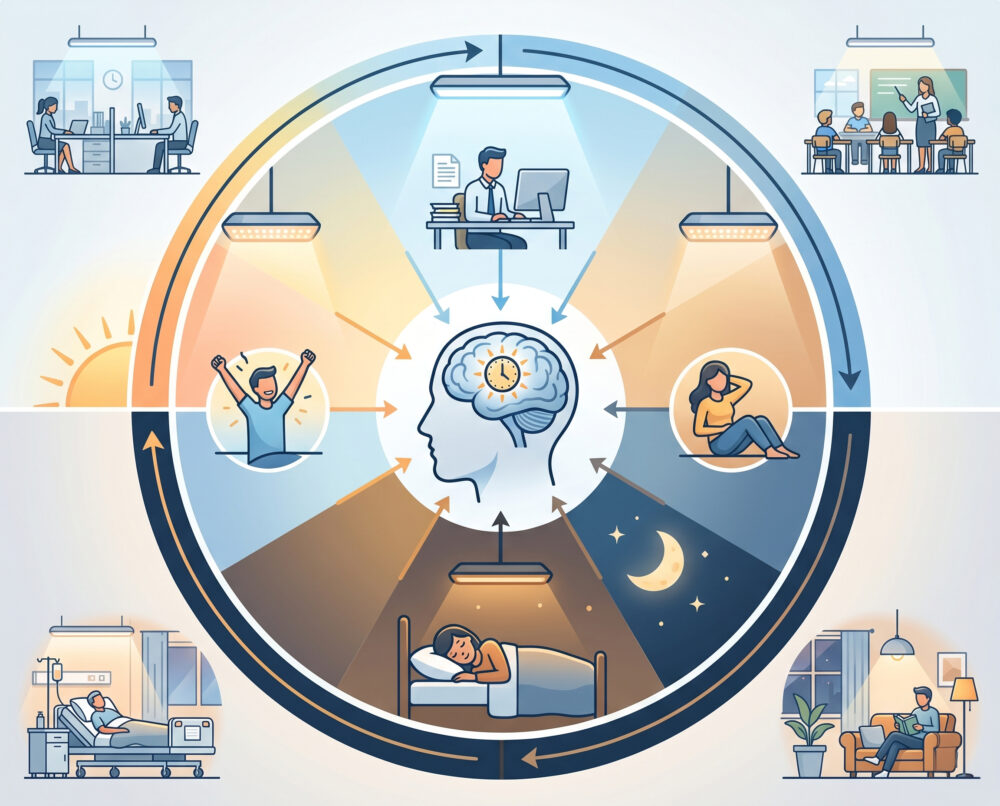
Human Centric Lighting is an approach to lighting design that considers the biological, emotional, and visual needs of people, not just illumination levels or energy efficiency.
At its core, HCL is rooted in the science of how light impacts the human body—especially our circadian rhythm, the internal clock that regulates sleep, alertness, hormone production, and overall well-being.
Most scientists would agree that our Circadian Rhythm is heavily influenced by light exposure—particularly the intensity and spectrum of light throughout the day.
In practical terms, HCL systems aim to mimic natural daylight patterns by adjusting:
-Color temperature (CCT) – warmer tones in the morning/evening, cooler mid-day
-Light intensity – brighter during active hours, dimmer during rest periods
–Timing and distribution – aligning artificial light with natural biological cues
This is often achieved using tunable white LED systems, controls, and automation.
Why Should the Lighting Industry Care?
1. Lighting Is No Longer Just About Visibility
For decades, lighting design focused on meeting minimum foot-candle requirements. That’s no longer enough. Today, lighting influences:
-Cognitive performance
-Mood and mental health
-Sleep quality
-Productivity
This shift transforms lighting from a commodity into a strategic design tool.
2. Science Is Changing What’s Included In The Lighting Spec
Research from organizations like the Lighting Research Center and the International WELL Building Institute is reshaping how lighting is evaluated.
Metrics like:
-Melanopic lux
-Equivalent daylight illuminance (EDI)
-Circadian stimulus (CS)
…are entering the specification conversation alongside lumens and watts.
For specifying engineers, this means a growing expectation to understand biological lighting metrics, not just photometric ones.
3. Codes and Standards Are Catching Up
While energy codes like Title 24 still dominate compliance discussions, wellness-focused standards are gaining traction.
Programs like:
-WELL Building Standard
-LEED (with increasing attention to occupant wellness)
…are pushing lighting designers to consider human outcomes, not just energy savings.
4. End Users Are Asking for It
HCL isn’t just theoretical—it’s being driven by real-world demand across sectors:
-Healthcare: Supporting patient recovery and staff alertness
-Education: Enhancing student focus and performance
-Office spaces: Improving productivity and reducing fatigue
-Retail & hospitality: Creating more engaging environments
In competitive projects, HCL can be the differentiator that wins a specification or a job.
5. LED Technology Finally Makes It Practical
Human Centric Lighting wouldn’t be feasible at scale without advances in LED technology.
Modern systems offer:
-Tunable white and full-spectrum control
-Integrated sensors and control systems
-Scalable digital lighting platforms
Manufacturers and engineers now have the tools to design lighting that adapts in real time to human needs.
When it comes to HCL there are still many challenges:
-Lack of standardization: Metrics and definitions are still evolving
-Overpromising outcomes: Not every “tunable” system delivers true circadian benefits
-Cost perception: Some clients still see HCL as a luxury rather than a value driver
–Education gap: Many stakeholders don’t fully understand how to implement it effectively
The industry’s role is to separate science from marketing and deliver solutions grounded in real, measurable outcomes.
Human Centric Lighting represents a fundamental shift in how we think about illumination. It aligns perfectly with broader trends in:
-Smart buildings
-IoT integration
-Wellness-focused design
-Data-driven environments
For lighting professionals who have seen many different evolutions and trends in this industry, I don’t believe this isn’t just another trend that will come and go—it’s a directional change in the industry.
Those who understand it, design for it, commercialize it and communicate its value will be better positioned to lead in the next generation of lighting. That’s why it should matter to you.
We’ve spent decades optimizing lighting for efficiency. Now, we’re optimizing it for people.
And that’s not just good design—it’s good business!