

What do we need to know?
LED Emergency Battery Backup Drivers
LED emergency battery backup drivers are specialized power supply devices that ensure LED lighting continues to operate during a power outage. They are essential in commercial, industrial, and residential settings where safety and visibility must be maintained during emergencies.
What Is an LED Emergency Driver?
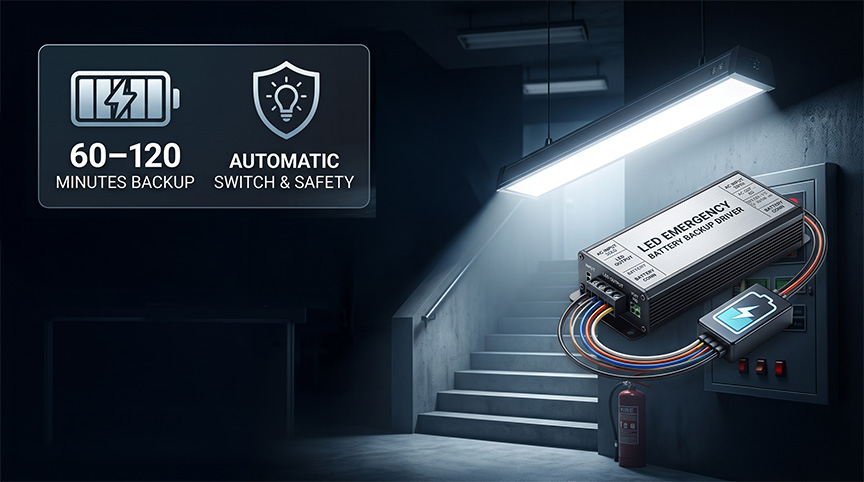
An LED emergency driver is an electronic device integrated into or connected with an LED fixture. It automatically switches to battery power when the normal AC power supply fails, allowing the light to remain on for a specified duration (typically 60–120 minutes).

Key Components
• Rechargeable Battery: Stores energy for emergency use.
• Control Circuit: Detects power loss and manages switching power line. During normal operation, it keeps the battery fully charged. The moment it detects a voltage drop or power failure; it instantly switches the fixture over to battery mode.
• LED Driver Circuit/Inverter: Regulates current/power flow to run the LEDs during both normal and emergency modes.
• Test Switch & Indicator Light: Allows manual testing and shows system status.
Types of Emergency Drivers
- Integrated Emergency Drivers
• Built directly into the LED fixture
• Compact and easy to install
• Common in modern LED panels and troffers - External Emergency Drivers
• Installed separately from the LED fixture
• Can be retrofitted to existing lighting systems
• More flexible for upgrades
Regulations & Standards
The National Fire Protection Association (NFPA) Life Safety Code 101 lists requirements for emergency lighting systems including emergency drivers.
• NFPA 101 Section 7.9.1
This section specifies the types of buildings that require emergency lighting systems. These include, but are not limited to, all buildings required by Chapters 11 through 43 of the Code, underground structures listed in Section 11.7 of the Code, and all high-rise buildings required by the Code. This section also states that the energy change between the main power line and the battery backup must not last more than 10 seconds.
• NFPA 101 Section 7.9.2
Section 7.9.2 requires emergency lighting systems must always be in operation or be automatically turned on. Emergency drivers must provide at least 90 minutes of backup power. Initial illumination must average 1 ft-candle but no less than 0.1 ft-candle along the floor level of the egress. At 90 minutes, emergency lighting must average 0.6 ft-candle but no less than 0.06 ft-candle at any distance along the egress. This section also mandates that emergency backup battery systems be listed to UL-924 Standard for Emergency Lighting and Power Equipment. UL-924 sets forth performance and testing standards for emergency lighting systems. All our emergency backup drivers are UL-listed to meet these NFPA Life Safety Code requirements.
• NFPA 101 Section 7.9.3
Section 7.9.3 of the NFPA 101 details the periodic testing of emergency lighting equipment, which varies depending on the specific type of equipment. Most LED emergency drivers are considered “self-diagnostic battery-operated emergency lighting equipment,” and testing for these devices must be conducted at least every 30 days for at least 30 seconds. A visual test shall also be conducted no less than once every 30 days, and annual functional testing must last at least 90 minutes. A status indicator on the driver should clearly show testing failures.
NaturaLED Emergency Driver key features:
o Automatic Transfer: Seamless switch from AC to battery
o Self-Test Function: Periodic automatic system checks
o Universal Compatibility: Works with various LED fixtures
o Output Power Control: Maintains safe power levels for LEDs
o Compliance: Meets safety standards (e.g., UL 924)


