

The lighting industry has evolved significantly toward smarter, more connected solutions driven by advances in digital technology, energy efficiency, and user-centric design.
Traditionally, lighting systems were simple and static, focusing mainly on illumination. Today, they are becoming intelligent ecosystems integrated with sensors, wireless communication, and software platforms. Smart lighting systems can automatically adjust brightness, color temperature, and timing based on occupancy, daylight levels, or user preferences. This not only enhances comfort and productivity but also delivers substantial energy savings.
A key driver of this transformation is the adoption of LED technology. LEDs are highly efficient, long-lasting, and easily controllable, making them ideal for smart applications. Combined with Bluetooth/Wi-Fi connectivity, our naturaLED lighting fixtures can now be controlled wirelessly using a remote programmer control.
Overview
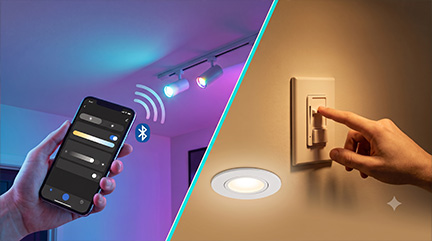
Bluetooth controlled LED lighting uses wireless communication via a smartphone, tablet, or remote app to adjust lighting settings such as brightness, color, and timing. On the other hand, manually controlled LED lighting relies on physical switches, dimmers, or knobs to operate. No connectivity or smart features are involved.
We, at naturaLED, are proud to offer various lighting categories that come with Z10 controllers to eliminate the need for complex wiring or internal driver modifications. Z10 controller is a twist and lock, plug and play device designed to mount onto commercial LED fixtures for ease of use and time saver.
Z10 socket is a standardized receptacle designed for adding low-voltage controls to 0-10v dimmable luminaires. Z10 socket ensures plug-and-play compatibility and works seamlessly with a variety of devices, including light and occupancy sensors, networked controls, and third-party control devices that are compatible with the Z10 standard.

“Z” refers to a flanged base style and the “10” indicates the size of approximately 10mm diameter.

How does the Z10 controller work?
The Z10 controller plugs into a fixture-mounted Z10 receptacle to bridge the gap between wireless network signals and the LED driver.
- Signal Reception: The controller acts as a receiver on a network (such as Bluetooth Mesh or Wi-Fi). It receives instructions from sensors, scheduling gateways, or smart devices.
- Signal Translation: It translates those wireless instructions into low-voltage signals (usually 0-10V).
- Driver Communication: Those low-voltage signals are sent to the LED driver to adjust dimming levels, set color temperatures, or trigger on/off states.
Advantages of Z10 controller:
- Ease of installation: It is tool-less operation. Instead of manually punching knockouts and hardwiring sensors into a light fixture, simply unscrew the Z10 protective cap, align the 4 pins, and twist the controller into place. The installation costs can be kept at minimal.
- Time savers: Controls can be added or swapped out without requiring technicians to disassemble the fixture.
- Scalability: Z10 devices support networked smart building standards.
- Space saving: It is ideal to work with compact luminaire design.
Conclusion
The lighting industry is rapidly evolving toward smarter, more efficient solutions—and Z10 controller is leading to that transformation.
Z10 controller isn’t just a trend; it represents a smarter, leaner approach to building next-generation photocell control systems. With its compact design, integrated dimming capabilities, and seamless compatibility with emerging smart technologies, Z10 is poised to replace traditional NEMA sockets across a wide range of applications.
naturaLED is at the forefront of this shift, delivering proven Z10 wireless solutions designed for ease of use, reliability, and performance. Our lighting fixtures are UL and ETL listed, incorporating the latest innovations to meet modern demands.
We are committed to delivering lighting solutions that maximize efficiency, increase flexibility, and elevate performance—empowering our customers to stay ahead in today’s increasingly connected and intelligent lighting landscape.

