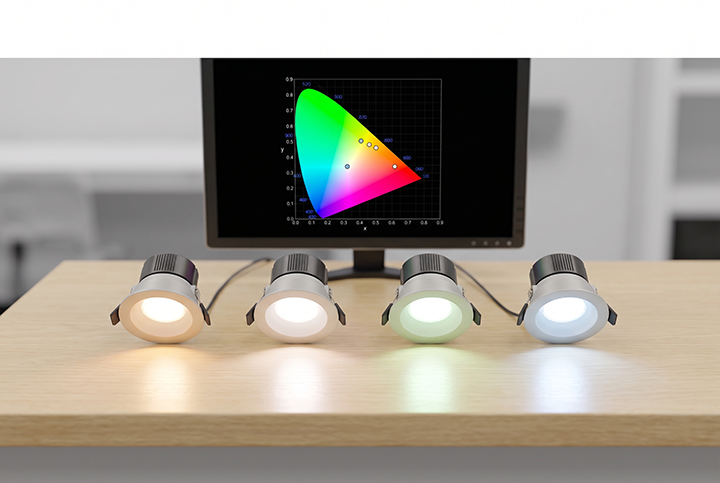
When we talk about LED lighting, we often describe light using familiar terms such as color temperature (2700K, 3000K, 4000K, 5000K etc.) and CRI (80 CRI, 90 CRI). These specifications are important, but they don’t tell the entire story of what color a light source will actually produce.
At the center of that story is chromaticity.
Chromaticity is the science of describing the color characteristics of light independently of its intensity. It helps explain why two LED products can both be labeled 3000K / 90 CRI and still look slightly different—and why controlling the chromaticity of LEDs is critical for producing consistent lighting installations.
What Exactly Is Chromaticity?
To understand chromaticity, it helps to separate two characteristics of light: how much light there is and what color that light is.
The amount of light produced is related to quantities such as lumens and illuminance. Chromaticity, on the other hand, describes the color characteristics of that light.
A light source’s chromaticity can be represented using coordinates on a chromaticity diagram. One of the most familiar is the CIE 1931 chromaticity diagram, developed from color-matching experiments conducted in the early 20th century.
The diagram provides a mathematical way to represent the colors humans can perceive. For white LED lighting, the most important area is the portion of the diagram surrounding the range of colors we generally perceive as white light.
This is where CCT, Duv, and chromaticity tolerances become important.
The Chromaticity Diagram
The CIE chromaticity diagram can be thought of as a map of color.
Instead of describing a light source simply as “warm white” or “cool white,” its color can be represented by specific chromaticity coordinates, traditionally expressed as x and y values.
For example, two LED sources might both have a nominal CCT of 4000K, but their actual chromaticity coordinates can be slightly different.
That difference can be enough to change the visual appearance of the light.
One source might appear slightly greener, while another might appear slightly pinker. Neither necessarily has the “wrong” CCT. Their chromaticity simply falls in different locations around the nominal 4000K region.
This is one of the reasons chromaticity is so important in LED manufacturing.
CCT Is a Way of Describing Chromaticity
Correlated Color Temperature, or CCT, is not the same thing as chromaticity.
CCT is a convenient way of describing the apparent color of white light by comparing its chromaticity to the color produced by an idealized blackbody radiator.
That gives lighting professionals a familiar scale:
• 2700K: Warm, yellowish white
• 3000K: Warm white
• 3500K: Neutral/warm-neutral white
• 4000K: Neutral or cool white
• 5000K: Daylight-like white
• 6500K: Cool daylight-like white
CCT is extremely useful because it gives designers, contractors, and end users an easy way to communicate the general appearance of white light.
But CCT reduces a complex chromaticity location to a single number. That’s why two LEDs with the same CCT can still look different.
The Blackbody Locus
One of the most important features of the chromaticity diagram is the blackbody locus, sometimes called the Planckian locus.
It represents the chromaticity of light produced by an ideal blackbody as its temperature changes.
As the theoretical temperature increases, the color moves through a familiar progression from reddish/orange light toward yellow, white, and eventually bluish-white light.
The Kelvin temperatures used for CCT correspond to positions along this general path.
But LEDs do not necessarily fall directly on the blackbody locus.
Their chromaticity can fall slightly above or below it.
That’s where Duv becomes useful.
Duv: The Other Side of the Chromaticity Story
Duv describes the distance between an LED’s chromaticity and the blackbody locus.
It provides information that CCT alone cannot.
A light source with a positive Duv tends toward a greenish appearance relative to the blackbody locus. A source with a negative Duv tends toward a pinkish or magenta appearance.
This difference can be subtle, but it can become much more noticeable when multiple fixtures are installed next to one another.
For example, imagine a commercial space with twenty 4000K LED downlights. If all twenty fixtures have tightly controlled chromaticity, the ceiling can appear visually uniform.
If some fixtures have chromaticity that shifts toward green while others shift toward pink, the differences can become visible—even though every fixture is technically labeled 4000K.
This is why CCT by itself isn’t always enough to guarantee color consistency.
Chromaticity and LED Binning
Controlling chromaticity is one of the major challenges in LED manufacturing.
LEDs are semiconductor devices, and individual LEDs manufactured during the same production process do not necessarily produce exactly the same color.
Manufacturers therefore sort LEDs according to their optical characteristics. This process is commonly referred to as binning.
LEDs can be categorized according to characteristics such as:
• CCT
• Chromaticity coordinates
• Luminous flux
• Forward voltage
• Other performance characteristics
By controlling which LED bins are used in a fixture, manufacturers can improve consistency from one product to another.
For professional lighting applications, tighter chromaticity control can be particularly important.
MacAdam Ellipses and Color Consistency
One of the concepts used to describe chromaticity consistency is the MacAdam ellipse.
A MacAdam ellipse represents a region around a chromaticity point where color differences are expected to be relatively difficult for an average observer to distinguish.
Today, LED specifications may refer to chromaticity tolerances in terms of MacAdam steps, such as 3-step or 5-step.
Generally, a smaller number of steps indicates tighter chromaticity control.
For example, a fixture specified with a tighter chromaticity tolerance is more likely to look visually consistent with another fixture of the same model and CCT.
This matters particularly in installations containing large numbers of fixtures.
Think about:
• Long rows of recessed downlights
• Retail stores
• Grocery stores
• Offices
• Hotels
• Museums
• Architectural linear lighting
• Wall-washing applications
In these environments, even relatively small color differences can become apparent because fixtures are viewed side by side.
Where Does CRI Fit In?
CRI, or Color Rendering Index, is related to color—but it measures something different from chromaticity.
Chromaticity describes the color characteristics of the light source itself.
CRI describes how effectively that light source reveals the colors of objects.
For example, two LED lamps can both have a chromaticity corresponding approximately to 3000K while having different CRI values.
A 3000K, 80 CRI LED and a 3000K, 90 CRI LED may produce a similar general white-light appearance, but colored objects under the two sources may appear different.
Chromaticity = What color is the light? CRI = How accurately does the light reveal colors?
This distinction is important when evaluating LED products.
Why Two “Identical” LEDs Can Look Different
Consider two fixtures both specified as:
4000K • 90 CRI
At first glance, they appear identical on paper.
But those numbers don’t necessarily tell us their exact chromaticity coordinates or Duv.
One fixture could be slightly above the blackbody locus and have a subtle green shift. The other could be slightly below it and have a subtle pink shift.
Both can legitimately be called 4000K.
Place them next to one another, however, and the difference may become obvious.
This is one of the most important practical reasons to understand chromaticity and work with a quality manufacturer who understands chromaticity and Duv.
Chromaticity Becomes Even More Important With LED
Traditional light sources also have color characteristics, but LED technology has made chromaticity control an increasingly important part of lighting design and manufacturing.
LED systems can be engineered with extremely specific optical characteristics. That creates opportunities for excellent color consistency—but it also makes small differences between products easier to identify.
The closer fixtures are to one another and the more uniform the surrounding environment is, the more noticeable differences in chromaticity can become.
A single fixture in an isolated room may look perfectly acceptable.
Place that same fixture next to 50 other fixtures, and small variations can suddenly become much easier to see.
Chromaticity: The Hidden Specification Behind Consistent Light
CCT may be the number most people see on an LED package, but chromaticity is the underlying science that helps define what that light actually looks like.
A 3000K LED isn’t simply a single, universally identical color. Its actual chromaticity can vary within an allowable range. Understanding that range—and controlling it—is essential when consistency matters.
For lighting professionals, chromaticity provides a more precise way to think about LED color. It explains why two fixtures with the same CCT can look different, why Duv matters, how LED binning helps manufacturers control consistency, and why tighter chromaticity tolerances can make an installation look more uniform.
At naturaLED, we believe understanding the science behind LED lighting is just as important as understanding the products themselves.
Because when it comes to LED color, the number on the label is only part of the story.