
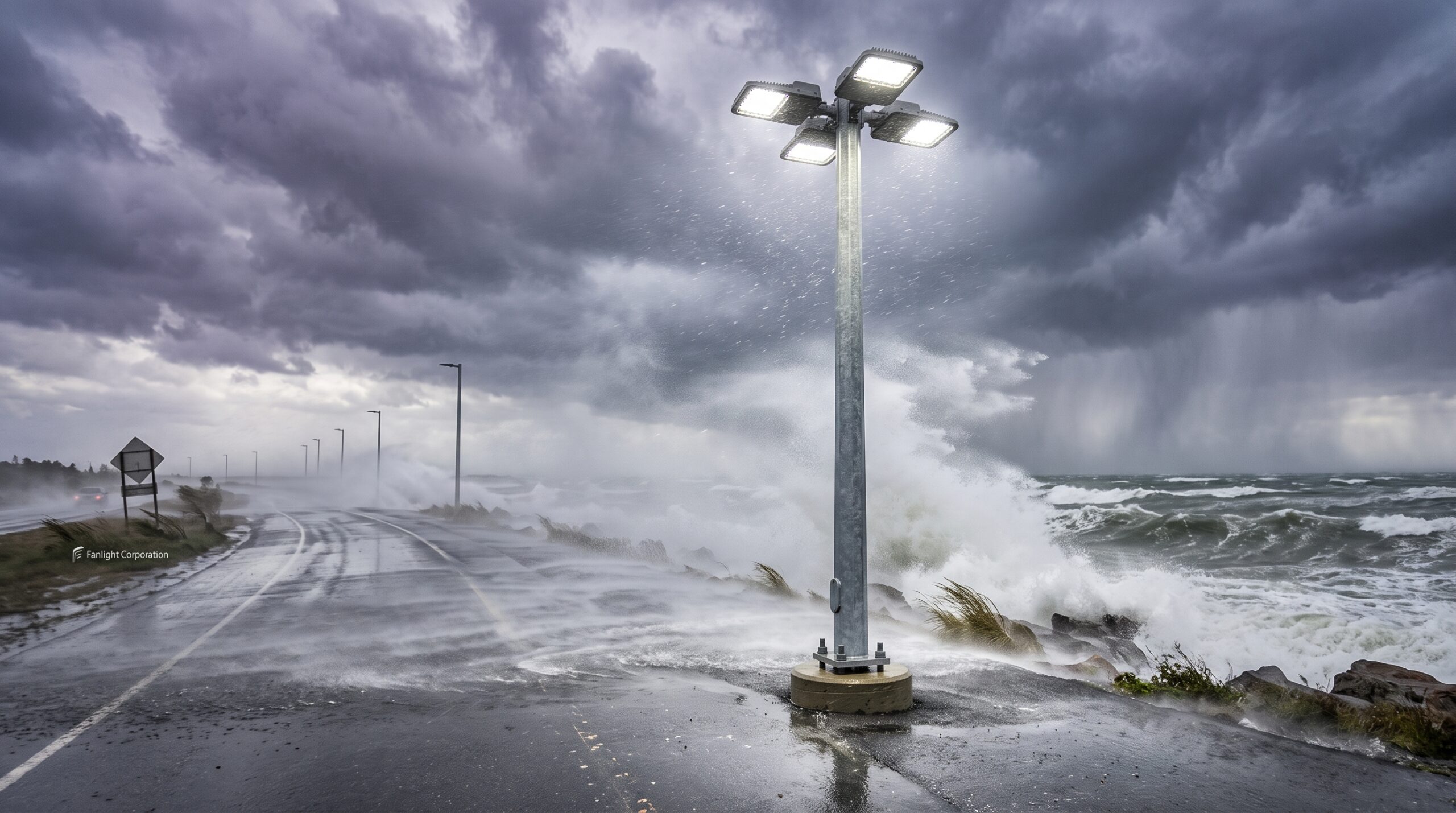

What do we need to know?
Pole-mounted area lighting systems shall be designed and installed to withstand site-specific wind loads in accordance with the applicable building code and structural design standards. The pole height, luminaire, mounting arm, anchor bolts, and foundation shall be engineered as a complete assembly to resist the design wind speed specified for the project location such as in coastal or mountain regions.

The effective projected area (EPA) of all attached equipment, including luminaires, brackets, banners, and accessories, shall not exceed the pole manufacturer’s published wind load capacity. Wind load calculations shall be based on the exposed pole height, luminaire configuration, and local environmental conditions. The selected pole and foundation system shall maintain structural integrity under ultimate wind loading conditions and provide an appropriate safety factor against overturning, excessive deflection, and fatigue. The higher the EPA values, the greater the wind exposure of the luminaire.

an appropriate safety factor against overturning, excessive deflection, and fatigue. The higher the EPA values, the greater the wind exposure of the luminaire.
Now the question is how much wind a luminaire can take?
Wind rating is not determined by the pole alone, but by the entire pole-and-fixture assembly.
1. Pole Height
Taller poles experience greater wind forces and bending moments.
Wind pressure increases with elevation above ground.
A 40-ft pole generally requires a stronger design than a 20-ft pole carrying the same fixture.
2. Effective Projected Area (EPA) and Weight

EPA is the surface area exposed to wind velocity. Luminaires, brackets, tenons, banners, cameras, and other accessories all contribute to EPA.
Higher EPA creates greater wind load on the structure.
Why EPAMatters for Your Pole Design?
Different equipment creates different wind loads. Even when two poles are the same height and wall thickness, they may need different structural designs depending on what will be mounted on them. A small roadway light affects the pole differently than a solar panel, double-arm bracket, CCTV camera, or communication cabinet.
How is EPA calculated?
EPA = Projected Area* (A) x Drag** Coefficient (Cd) x Gust Factor***.
* Projected Area of a luminaire is its max cross-sectional area including its mounting hardware.
** Drag coefficient is a number that determines how much a drag a given object’s shape and size will
produce in moving air. The number varies based on the shape of the fixtures.
*** Gust factor accounts for the increase in wind pressure.
Effective Projected Area (EPA) and dead weight on every item mounted on the pole are critical factors in outdoor lighting design because they help determine whether lighting fixtures, poles, and luminaires can withstand wind forces safely. Accurate EPA calculations support structural integrity, reduce the risk of wind-related damage, and help ensure long-term performance in outdoor conditions.
3. Number and Size of Fixtures
Multiple luminaires increase wind resistance.
Large LED area lights often have significantly greater EPA than smaller fixtures.
Twin- or quad-mounted fixtures require stronger poles than single-fixture installations.
4. Pole Shape and Material
Common materials include steel, aluminum, fiberglass, and concrete.
Round tapered poles typically offer better wind performance than poles with larger flat surfaces.
Material strength and wall thickness directly affect wind capacity.
5. Mounting Configuration
Side-mounted fixtures generate higher bending moments than top-mounted fixtures.
Long outreach arms increase the leverage effect of wind loads.
Decorative brackets and banner arms can substantially increase loading.
6. Local Design Wind Speed
Wind ratings are based on the project’s required design wind speed, typically determined by local building codes. Coastal, hurricane-prone, and high-wind regions require stronger pole designs.
Common design wind speeds range from 90 mph to over 170 mph depending on location.
7. Exposure Category
It describes the terrain surrounding a lighting pole and has a major impact on the wind loads used in the pole design. The more open the terrain, the higher the wind pressure and the lower the allowable EPA that a pole can support.
The surrounding terrain affects wind pressure:
Exposure B: Urban/suburban areas with buildings and trees.
Numerous buildings, trees, and obstructions.
Lowest wind pressures of the common categories.
Examples: shopping centers, office parks, residential developments.
Exposure C: Open terrain and grasslands.
Flat open land, grasslands, parking lots
Higher wind pressures than Exposure B
Examples: large parking lots, industrial sites, airports, agricultural areas.
Exposure D: Coastal areas exposed to large bodies of water or unobstructed coastal regions.
Highest wind pressures.
Examples: coastal shorelines, great lakes, waterfronts, open ocean-facing sites.
Exposure C and D result in significantly higher wind loads than Exposure B.
Why Exposure Matters?
Consider where the pole is located.
>Inside a developed city center (Exposure B):
Buildings and trees reduce wind speeds reaching the pole.
> In a large open parking lot (Exposure C):
Wind can act on the pole with much greater force because there are few obstructions.
> Near a waterfront (Exposure D):
Wind can travel long distances unobstructed, producing the highest loads.
Thus, the same pole and fixture package may be acceptable in Exposure B but fail the manufacturer’s wind-load criteria in Exposure C or D.
8. Foundation Design
Pole strength is only part of the system.
Anchor bolts, base plates, and concrete foundations must be designed for the same wind loads.
An undersized foundation can fail even if the pole itself meets the wind rating.
9. Additional Attachments
Items mounted to the pole can dramatically impact wind loading:
• Banners
• Security cameras
• Wireless communication equipment
• Signs
• Holiday decorations
In conclusion, here are some of the key factors in Wind Ratings:
• EPA (Effective Projected Area): Measured in square feet, EPA combines a fixture’s surface area (frontal projected area) and its aerodynamic shape (drag coefficient).
• Total Assembly Load: We must add together the EPA and weight of all attached components—including light fixtures, mounting arms, brackets, tenon adapters, and accessories like banners or cameras.
• Wind Speed & Zone: Local building codes and wind maps (provided by organizations like the American Society of Civil Engineers) dictate the design wind speed (mph) for our specific geographical area.
• Exposure Category: Surrounding terrain (open terrain versus urban environments with many buildings) changes the wind pressure acting on the pole.
Some common design standards for pole mounted area light to follow are:
 | AASHTO (American Association of State Highway and Transportation Officials) specifications for poles used with highway signs, lights, and traffic signals |
 | ASCE 7 (American Society of Civil Engineers) wind-load rules when the project requires building or structural wind design criteria |
 | EN 40 (European Standard) series for lighting columns for projects that follow European or international lighting-column standards; and local requirements from the highway authority, city, airport, or project owner. |

