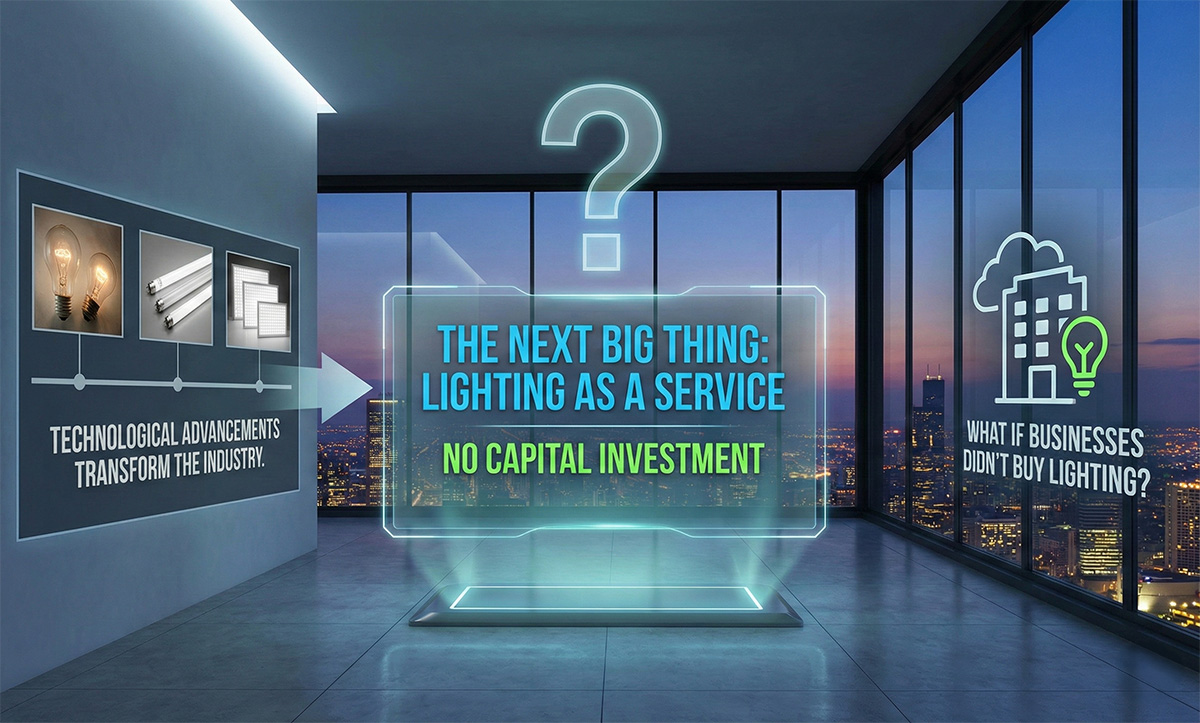
The lighting world has experienced big transformations in the past decades. Technological advancements have dramatically turned the industry upside down. It leads a person to wonder, what’s the next big thing. Could that “next big thing” be driven by a simple but powerful idea: what if businesses didn’t have to buy their lighting at all?
Lighting-as-a-Service (LaaS) takes that question and turns it into a modern, subscription-based model where a provider designs, installs, maintains, and upgrades an entire lighting system while the customer pays a set monthly fee. It’s a business model where a customer pays for light rather than purchasing lighting equipment outright, managing repairs, or worrying about outdated technology. The end users can treat lighting like any other essential service—reliable, maintained, and always up to date with the latest technology.
What makes this unique and special? Much of the appeal of this model comes from the financial shift alone. Traditional lighting retrofits often require large upfront capital budgets, making LED projects difficult or impossible for schools, municipalities, manufacturing facilities, and many businesses operating with tight financial constraints. LaaS removes that barrier by converting the cost into an operating expense, allowing organizations to upgrade immediately and begin benefiting from energy savings that frequently offset the subscription itself. For many customers, the decision becomes cash-flow positive from day one.
The model is gaining popularity not just because of the financial benefits, but because it eliminates guesswork. We all know by now that LEDs can reduce energy usage, and when paired with smart controls, the savings are even greater. LaaS providers typically guarantee performance, taking responsibility for maintenance, optimization, and repairs over the life of the agreement. Instead of hoping a project delivers savings, customers get expert oversight and ongoing system monitoring that ensures it does. This hands-off, outsourced expertise has become especially valuable as lighting technology grows more complex and integrated with building automation.
Rapid advancements in smart sensors, IOT connectivity, and data-driven lighting controls make the traditional ownership model feel outdated. With LaaS, equipment is upgraded as the industry evolves, preventing businesses from being stuck with obsolete technology just a few years after installation. Businesses don’t have to stay up on advancements, their LaaS partners do. That leaves them to focus on their core competencies and their business growth and shareholder value.
Industries of all kinds are gravitating toward LaaS—manufacturers, retailers, schools, hospitals, municipalities, and large commercial real-estate owners—because it offers a practical, low-risk path to modernization. The subscription model mirrors how companies already consume technology in other areas. Just as most organizations no longer buy servers but rely on cloud services, many are beginning to question why they should buy, maintain, and replace their own lighting systems.
As this shift accelerates, a natural question emerges: could Lighting-as-a-Service represent the future of the lighting industry? Increasingly, signs point to a strong… maybe!
Consumers are averse to change. However, the combination of financial flexibility, guaranteed performance, sustainability benefits, and built-in technological modernization positions LaaS as more than a trend—it’s a structural change in how lighting will be deployed and managed. As buildings become smarter and more connected, lighting will function less as an isolated electrical system and more as a dynamic part of a broader digital ecosystem. LaaS fits perfectly into that evolution.
So is Lighting-as-a-Service redefining expectations across the industry, offering a smarter, simpler, and more future-proof way to manage lighting. Yes, but is the world ready for this shift? That’s still to be seen. Whether it ultimately becomes the dominant model or not, it is already reshaping how some organizations think about energy, technology, and operational efficiency—and it’s a shift that’s only just beginning.